Why Some Stories Are Missing from American History
Alta California, as a territory was part of the Viceroyalty of New Spain since 1683 then was made part of the Mexican Empire in 1821. White illegal insurrectionists in Texas, Coahuila, México successfully took that part of the Mexican Empire to make the Republic of Texas on March 2, 1836. A decade later it was made part of the United States on December 29, 1846.
The US had declared war on Mexico and began armed, violent hostilities on April 25, 1846. No match for US troops and their thirst for expansion, México surrendered.
As was the case in Texas when it was part of México, thousands of Whites began the trek to the region, now beginning to be called just California. John Sutter, an illegal settler from Switzerland was one of those migrants. He saw a river and paid to have a water-powered saw mill set up on those foothills of the Sierra Nevada. He called it the American River and his mill, Sutter’s Mill. His settlement became Coloma, California, about 70 miles northeast of Sacramento. The illegal settlers would need lumber to build their homes and businesses. Sutter also set up a trading post and begin ranching. Hundreds more like him came to find opportunity in these lands in the following decade.
His business goal was to sell lumber to those in Yerba Buena and to William Alexander Leidesdorff, in Rancho Rio de los Americanos who owned the lumber yard and a hotel. Unlike Sutter, Leidesdorff was from the Virgin Islands, Saint Croix, who became a US citizen in 1834, then a Mexican citizen in 1844. He received a land grant from the Mexican government of 8 Leagues or 35, 500 acres just south of the Rio de los Americanos. Those two places became San Francisco and Folsom, California, respectively.
Sutter had hired James W. Marshall, a carpenter, to actually construct the sawmill by the river. On January 24, 1848, in the course of his labors Marshall found some gold flakes in the river bed. A flake of this gold was sent to US President James W. Polk who publicized the find to Congress. This flake is on exhibit at the Smithsonian National Museum of American History.[1] The ink on the print media of the time was not dry announcing the gold in California, that thousands more illegal migrants began the move West; approximately 300,000 by 1850. .
A few weeks later, on February 2, 1848, the Tratado de Guadalupe Hidalgo was signed ending the war with México. While the armed, violent hostilities officially ended, the removal of Mexicanos and taking of their properties continued unabated. Land, in particular, and precious gold, later silver, was taken at will without regard to compensation or lawful transfer from the owner.
The estimates were that some 750,000 pounds of gold was taken during the Gold Rush or about 12 million Troy ounces. In 1852 alone, some $81 million dollars’ worth of gold was produced in California.[2]
The New Corporate Global Gold Rush
In 2026, corporations from various sectors, including energy, technology, mining, and processing are investing heavily in the harvesting of valuable minerals from the ocean floor, a modern day Gold Rush. These organizations are driven by the growing demand for resources like cobalt, nickel, and rare earth elements, such as cerium, lanthanum, praseodymium, samarium, promethium, and neodymium to name a few. There minerals and rare earth finds are essential for manufacturing batteries, electronics, and green technologies. US corporations are not among the top five sea mining companies, but the technology sector is the top importer of these minerals and rare earth.[3]
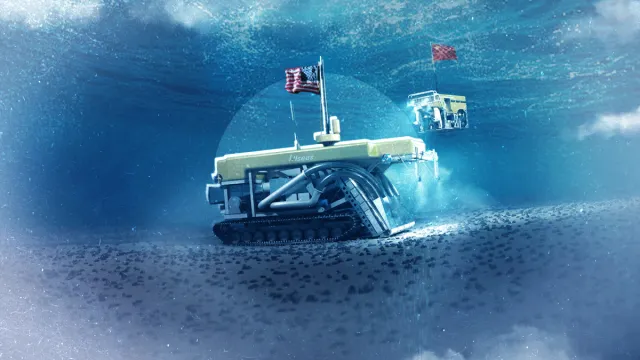
The global problem is two-fold; one being that 70% of the earth are oceans and there are no enforceable regulations in place to control sea mining. Like it was during the 1848 Gold Rush. Anybody with the vessels and special equipment can go harvest and mine these valuable minerals from the ocean floor. In 2026, there are sophisticated unmanned, robotic dredging machines that comb the ocean floor is search of rock nodules. These robots can see with powerful lighting and underwater cameras. They suck up the dredge where they see potential nuggets with huge vacuum machines for immediate processing.
Diamonds and Gold
The British De Beers company and Canadian companies like Nautilus, Metals Company, and Namco have made billions of dollars extracting diamonds from sea beds off Namibia and South Africa where the Orange River empties. In 1999, Namco reported a record 116,650 carets of diamonds picked up. That record was broken in 2002 when it reported 117,650 carets found. In 2022, China had cornered 10% of the global production of diamonds from sea mining in the Pacific Ocean. It is the top country engaged in sea mining followed by the United Kingdom, South Korea, Russia and Germany.
Between Mexico and Hawaii are 4,500 acres of sea bed that contain the largest amount of gold on the ocean floor. The area is known as the Clarion-Clifford Zone (CCZ). Lockheed-Martin is one of the principal corporate actors in the area.
The demand for gold, silver, cobalt, lithium, graphite, copper, nickel, bauxite, and chromium, the traditional valuable minerals has continued to go up in market value. The rare earth minerals are the latest valuable find.
The Law of the Sea Treaty
For decades, various countries, all members of the United Nations, have tried to enact an enforceable agreement between nations to regulate sea mining. The only agreement in place was the extra-territorial limit all countries must respect which was three-miles out from the coast line are the private domain of that country. Beyond that limit, are “international waters” belonging to no one. But not all countries continued to agree on that limit, some 92 countries went out from 4 to 12 miles out and 11 more remained with unspecified limits, as of 1960. On November 16, 1994, with 160 nations participating, agreement was reached on the UN Convention Law of the Sea (UNCLOS III). Agreement or consensus does not mean ratification.
Only 171 parties have ratified the agreement of which 167 are UN member countries, including China, Russia, Brazil, and India. The four other non-members of the UN are Palestine, Cook Islands, Niue, and the European Union. There are 13 UN member states that signed the UNCLOS III agreement but have not ratified it. Among these 13 are from South America: Colombia and El Salvador. From North America only the United States has not ratified the agreement.
The United States has not ratified the agreement on the International Court of Justice (ICC) either which means that the US can do what it pleases out in the oceans of the world and cannot be charged with any crime for violating the Law of the Sea or other agreements on genocide, torture, piracy, assassination, kidnapping, military strikes, nuclear proliferation, economic blockades, and many other crimes committed by executives in countries. Lately, the US has been committing such crimes in the high seas such as bombing fishing boats and taking an oil tanker of the coast of Venezuela. The bombing in Nigeria, Yemen, Iran, Syria, and genocide in Gaza by supplying weapons to Israel who is the aggressor in Palestine are other examples
The big difference between the US and Colombia and El Salvador not being parties to UNCLOS III is that they have no big ships involved in sea mining. US companies do have such vessels and many are headquartered in the US or other countries. Some of the major US corporations involved in sea mining are Infinity out of Houston, Deep Green Metals, Seabed Mining and Global Sea Mining Resources a US company headquartered in Belgium. TransOceans is another US company but based in Switzerland. The number one sea mining company is Moana Minerals which has been mining the sea floor of the Cook Islands for years without much competition.
Related to sea mining is fishing. The corporations with the larger vessels and equipment can fish anywhere they please. Of course, they take all the fish they want.
All of this, mining and fishing is like the saying, “finders keepers.”
[1]www.folsomhistory.org/post/folsoms-gold-flake/
[2]www.americanbullion.com/how-much-gold-was-found-in-the-gold-rush/
[3] Chris Miller, Chip War: The Fight for the World’s Most Critical Technologies, New York” Scribner, 2022.